SLS Rocket
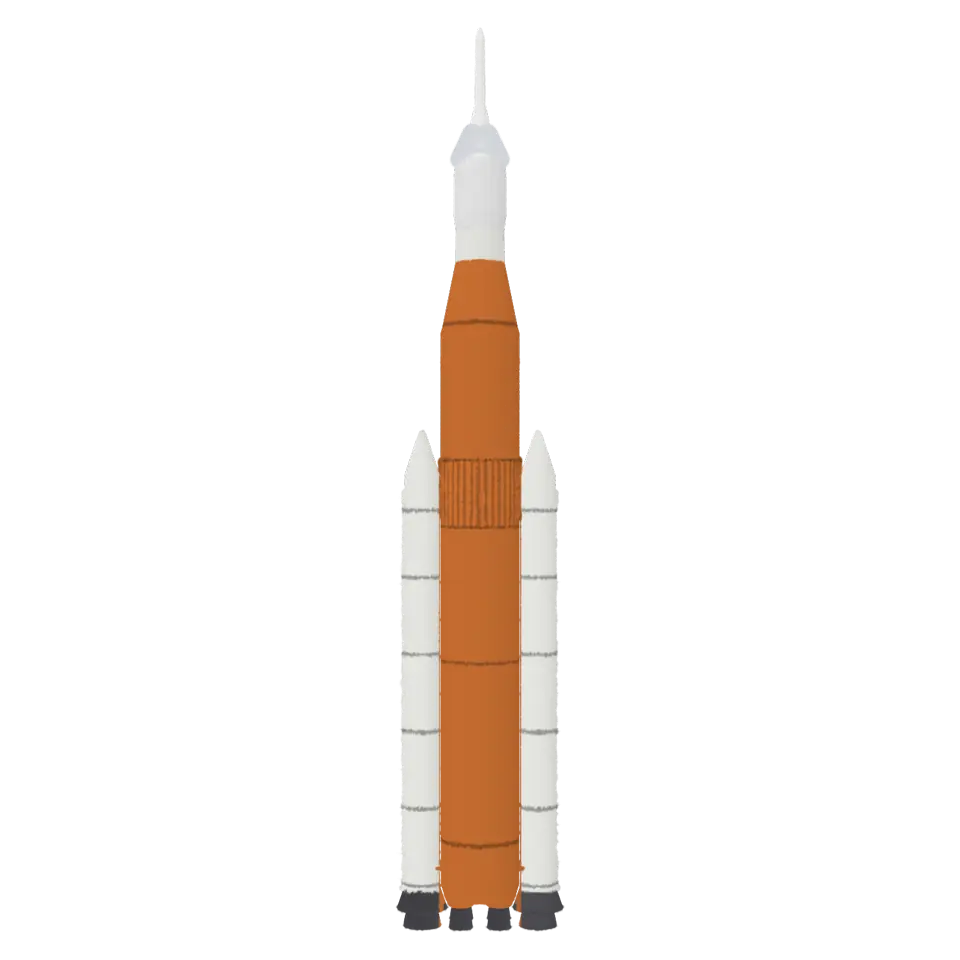
The Space Launch System, NASA's rocket for the Artemis missions back to the Moon, as splats from NASA's 3D model, colored as it flew on Artemis I in November 2022.
This picture is a cloud of paint. You can , , , , , , and .
Paint with your finger. It stays on these splats, wherever they go next.
Your paint is on this cloud. to see the sharp picture.
- Shelf
- Space
- Kind
- Built from a recipe
- Made from
- NASA's model of the Space Launch System, colored as it flew on Artemis I. A tap fires its stages in the order of the flight, much faster: the boosters, the abort tower, the core stage, then Orion leaves the upper stage.
- Sound
- Yes
- Licenses
- US government work
How to play
Tap to fire its stages in the order of a real flight.
Its controls
| Control | Kind | Range | Start |
|---|---|---|---|
| Fire the stages in order | Tap | ||
| Stage it | Button |
About it
The Space Launch System, NASA's rocket for the Artemis missions back to the Moon, as splats from NASA's 3D model, colored as it flew on Artemis I in November 2022. Its orange core stage burns four RS-25 engines once flown on the Space Shuttle, and two solid rocket boosters give most of the push at liftoff. On top ride the upper stage and the Orion spacecraft under its launch abort system.
Tap to stage it in Artemis I's order, much faster than real: the boosters fall away about two minutes after launch, then the abort tower; the core stage goes about eight and a half minutes in, at orbit; the upper stage then sends Orion toward the Moon, and Orion leaves it. Orion's capsule, hidden in the model, is drawn as a plain cone.
Is it right?
NASA's 3D model of the Space Launch System, cut into its pieces by its profile, colored as it flew on Artemis I, staging in the flight's order, much faster than real.
Correct
The pieces separate in the order of Artemis I: the two boosters, the launch abort system, the core stage, then Orion leaves the upper stage (the ICPS).12
The drive moves each piece at its time on a 12-second clock; the test checks the order and that the boosters fall away to both sides, tilting outward.
Close
The core stage is orange and the boosters, upper stage and Orion white, as on Artemis I.
tools/sp2-rockets.mjs colors the model's pieces (the printable model has no color).
Correct
The model is NASA's, used under NASA's media guidelines, and carries no logo.3
The printable model is one untextured solid; the test checks the GLB has no image or texture.
- Space Launch System Solid Rocket Booster, NASA
- Artemis I, Wikipedia
- Images and media usage guidelines, NASA
- Simplified
- Staging that took hours is shown in 12 seconds.
- Simplified
- The flames are glowing cones, not a simulation of the exhaust.
- Simplified
- Orion's crew module, hidden under the abort system's fairing in the model, is drawn as a plain cone.
- Simplified
- The model is simplified to about 48,000 triangles.
Sources and credits
Share it
This link opens it in the Playground. To put it on your own page, add the element and one script tag. Every option.
https://splashery.app/play/?toy=sls
<script type="module" src="https://splashery.app/play/src/element.js"></script>
<splashery-toy toy="sls"></splashery-toy>
Nearby
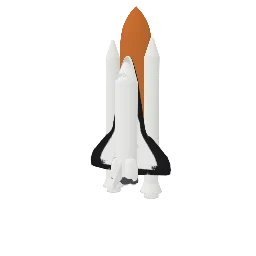 Space ShuttleThe Space Shuttle at launch, as splats from NASA's 3D model: the winged orbiter, the big orange external tank that fed its three main engines with liquid hydrogen and oxygen, and the two white solid rocket boosters.
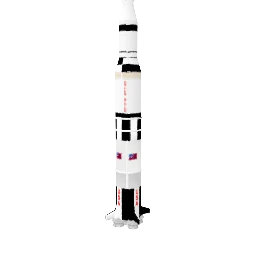 Saturn VThe Saturn V, the rocket that sent astronauts to the Moon from 1968 to 1972, as splats from NASA's 3D model.
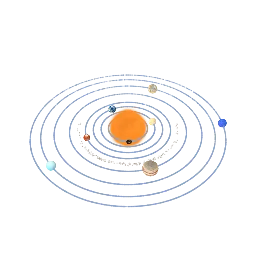 Solar ModelThe solar system is the Sun and everything that circles it: eight planets, their moons, and many asteroids and comets.
 Tiny PlanetA tiny, made-up planet built by the computer from a sphere and a palette of planet colors: blue seas, green land and white clouds for Earth, rusty deserts and white polar caps for Mars, gray craters for the Moon, and banded storms for Jupiter and Neptune.