Half Adder
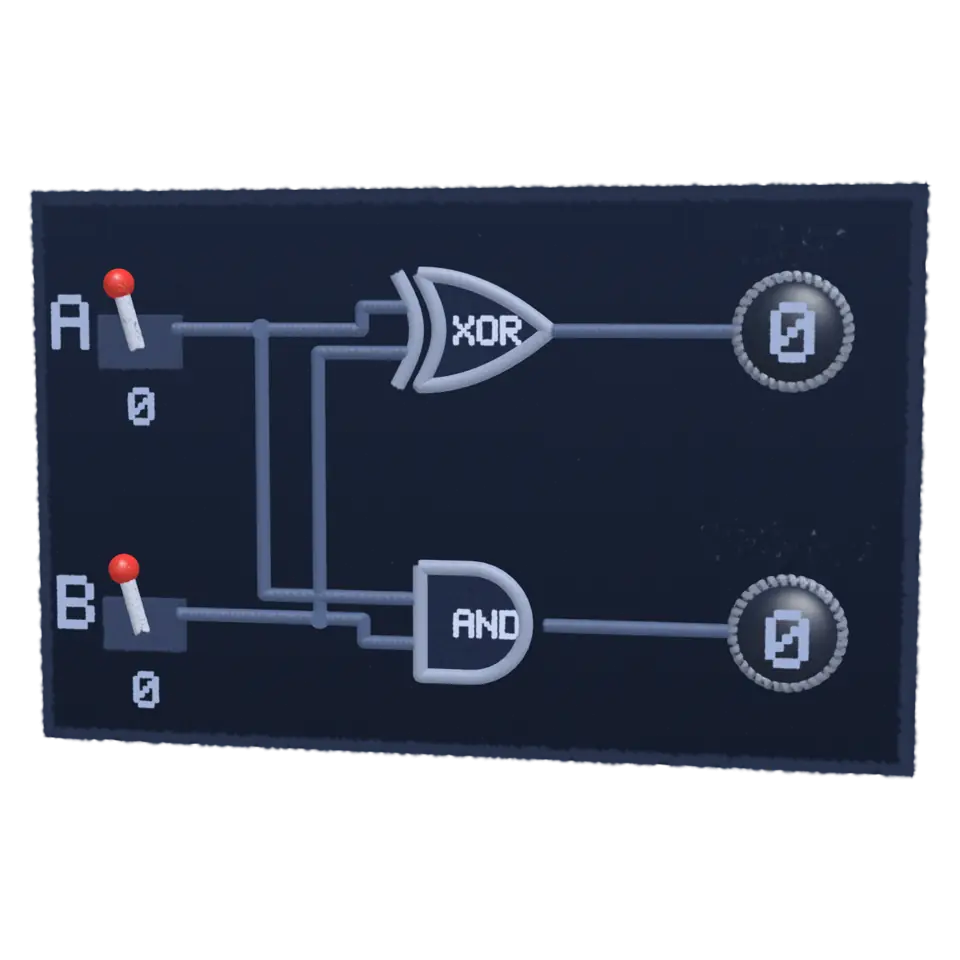
A half adder adds two bits, each 0 or 1.
This picture is a cloud of paint. You can , , , , , , and .
Paint with your finger. It stays on these splats, wherever they go next.
Your paint is on this cloud. to see the sharp picture.
- Shelf
- AI and Computing
- Kind
- Built from a recipe
- Sound
- Yes
- Hands-on
- Yes
- Licenses
- Own work (made in the page)
How to play
Tap it to add 1 + 1. Hands-on: flip each lever by hand; the lamps show the sum.
Its controls
| Control | Kind | Range | Start |
|---|---|---|---|
| Add 1 + 1 | Tap | ||
| Add | Button |
About it
A half adder adds two bits, each 0 or 1. Its XOR gate gives the sum bit: 1 when exactly one input is 1. Its AND gate gives the carry: 1 when both inputs are 1. With carry written first, 0 + 0 gives 00, 0 + 1 and 1 + 0 give 01, and 1 + 1 gives 10.
Tap to watch the fixed 1 + 1 example. Both switches flip to 1, light travels through the gates, and only the carry lamp lights: binary 10 means two. Then the switches reset. There is no incoming carry on a half adder. Two half adders plus an OR gate can make a full adder, which also accepts that carry; chaining full adders adds longer binary numbers. With ✋ Hands-on on, flip each lever by hand: the lamps show the sum and the carry of the two bits at once, so 0 + 1 = 1 and 1 + 1 = 10.
Details
- Splats
- Opens at 200,000 at Mid Detail, 59,638 at Low, and up to 640,000 at Max
Is it right?
The gate explanation and fixed 1 + 1 example are correct. The animation lights the carry and leaves the sum dark, giving binary 10. It does not let the reader choose all four input pairs.
Correct
XOR produces the sum and AND produces the carry.1
The About truth table gives 00, 01, 01, 10 for 0+0, 0+1, 1+0, 1+1; the actual fixed animation ends at carry 1 and sum 0.
Correct
The animated answer for 1 + 1 is binary 10.1
Both input lamps become one, only the carry output lights, and the sequence then resets. This also runs in the browser.
Correct
A half adder has no incoming carry; a full adder can combine two half adders and an OR gate.1
The About text distinguishes the two circuits; no full adder is presented as part of this splash.
Simplified
The circuit picture repeats a fixed worked example.1
The driver selects display stages; there is no input-dependent Boolean evaluator for all four cases.
- Half adder, All About Circuits textbook
- Simplified
- Only the fixed 1 + 1 sequence is animated. The other truth-table rows are explained in the About text, not computed by interactive inputs.
Sources and credits
Made in Splashery. Its code is MIT.
Share it
This link opens it in the Playground. To put it on your own page, add the element and one script tag. Every option.
https://splashery.app/play/?toy=half-adder
<script type="module" src="https://splashery.app/play/src/element.js"></script>
<splashery-toy toy="half-adder"></splashery-toy>
Nearby
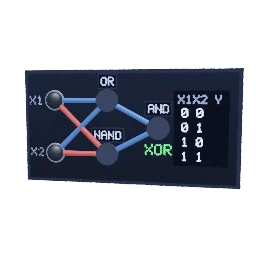 Multilayer NetOne perceptron can only split its inputs with a single straight line, so it cannot learn XOR, “exclusive or”, which is 1 when exactly one of two inputs is 1.
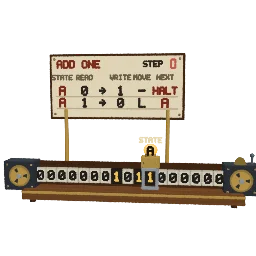 Turing MachineIn 1936 the mathematician Alan Turing imagined the simplest possible computer: a long tape of squares, a head that reads and writes one square at a time, and a short table of rules.
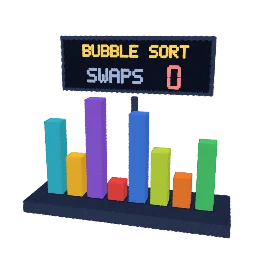 Sorting MachineA sorting algorithm is a step-by-step recipe a computer follows to put things in order.
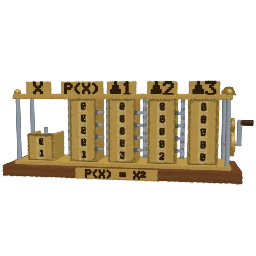 Difference EngineCharles Babbage designed Difference Engine No.