Splat Field
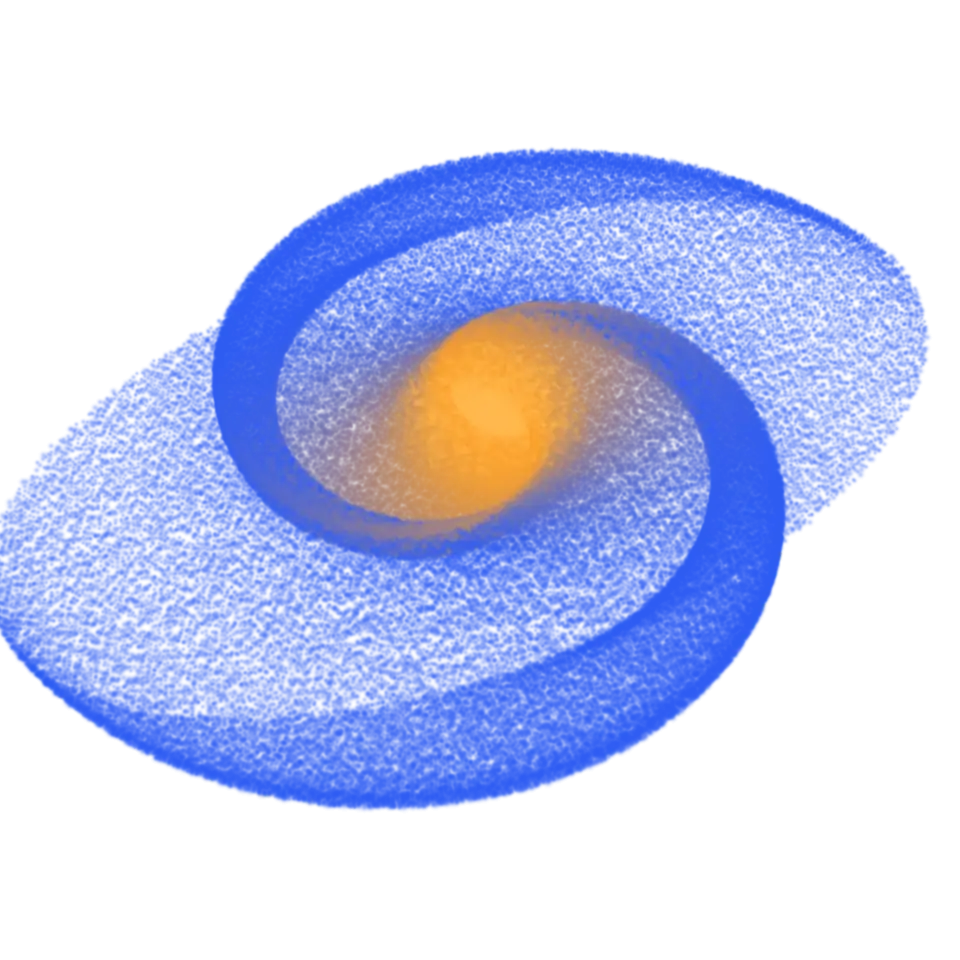
Hundreds of thousands of splats (the count depends on your device and the Detail setting), and the graphics chip works out where every one of them is, and its color, again every frame.
This picture is a cloud of paint. You can , , , , , , and .
Paint with your finger. It stays on these splats, wherever they go next.
Your paint is on this cloud. to see the sharp picture.
- Shelf
- Lab
- Kind
- Built from a recipe
- Sound
- Yes
- Licenses
- Own work (made in the page)
How to play
Tap to send a pulse through it; tap again for another. Pick a Field in the Splash tab.
Its controls
| Control | Kind | Range | Start |
|---|---|---|---|
| Send a pulse | Tap | ||
| Pulse | Button | ||
| Field | List | 3 choices | Galaxy |
About it
Hundreds of thousands of splats (the count depends on your device and the Detail setting), and the graphics chip works out where every one of them is, and its color, again every frame. Each splat only knows its own two numbers, u and v; a small program turns them and the time into a place. That is why so many splats can move smoothly at once.
The galaxy's stars each follow an oval orbit, turned a little more the farther out it is, so the ovals crowd into two spiral arms that stay while every star keeps moving. The ocean is four waves added together, each splat tilted to the water's slope, and the knot is a flow along a knotted tube. Tap to send a bright ring out through the galaxy, drop a stone in the sea where you tap, or push the flow once more around the knot. Each tap adds its own: tap the sea in a few places and the rings cross.
Details
- Splats
- Opens at 200,000 at Mid Detail, 89,100 at Low, and up to 200,000 at Max
Is it right?
The ocean and knot follow actual analytic coordinate formulas. The galaxy is prescribed orbital art and the taps add visual pulses. These fields demonstrate many parallel splat calculations, rather than validated galaxy or ocean dynamics.
Correct
The ocean adds four wave displacements.1
An independent four-wave formula matches 100 sampled positions to 12 decimal places, including the slowed time and horizontal scale.
Correct
The knot is a periodic flow around a knotted tube.2
Its centerline winds twice around one direction and three times around the other. Sampled positions repeat after 1/0.03 time units.
Simplified
The galaxy is an illustrative field rather than an astronomical simulation.3
Its coordinates use prescribed ellipses, rotation, and a small bulge. No masses or gravitational forces are integrated.
Simplified
GPU programs calculate field coordinates from u, v, and time.1
The pack supplies both shader languages and per-splat parameters; the CPU coordinate functions are checked independently.
- Effective Water Simulation from Physical Models, Mark Finch, GPU Gems, NVIDIA
- Torus Knot, Eric Weisstein, Wolfram MathWorld
- Ellipse, Eric Weisstein, Wolfram MathWorld
- Simplified
- The galaxy follows prescribed rotated ellipses and a small bulge, without gravity or interactions. Four wave formulas animate the ocean with slowed time and adjusted horizontal displacement. Tap ripples are added visual pulses. Smooth performance and particle count depend on the device and settings.
Sources and credits
Made in Splashery. Its code is MIT.
Share it
This link opens it in the Playground. To put it on your own page, add the element and one script tag. Every option.
https://splashery.app/play/?toy=splat-field
<script type="module" src="https://splashery.app/play/src/element.js"></script>
<splashery-toy toy="splat-field"></splashery-toy>