Pythagoras Proof
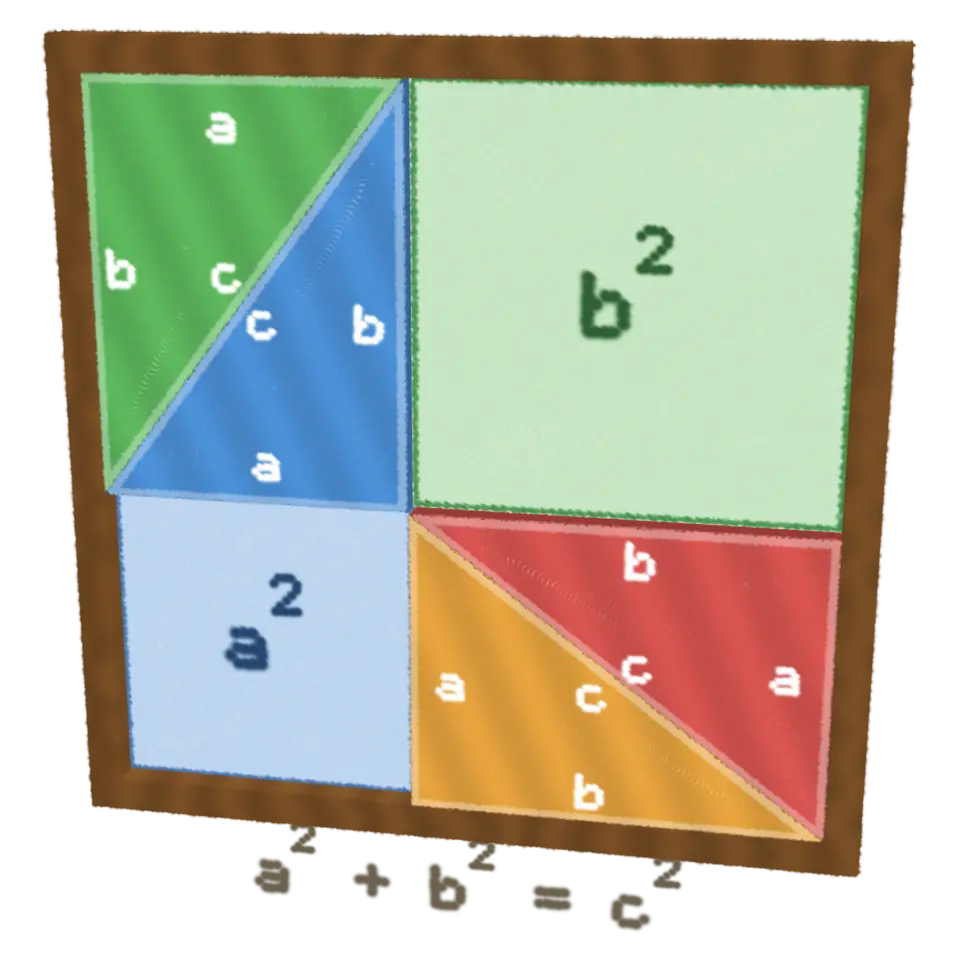
In a right triangle, the two short sides a and b and the long side c always fit a rule: a² + b² = c².
This picture is a cloud of paint. You can , , , , , , and .
Paint with your finger. It stays on these splats, wherever they go next.
Your paint is on this cloud. to see the sharp picture.
- Shelf
- Math
- Kind
- Built from a recipe
- Sound
- Yes
- Hands-on
- Yes
- Licenses
- Own work (made in the page)
How to play
Tap to rearrange. Hands-on: slide the triangles yourself to turn a² + b² into c².
Its controls
| Control | Kind | Range | Start |
|---|---|---|---|
| Rearrange | Tap | ||
| Prove | Button |
About it
In a right triangle, the two short sides a and b and the long side c always fit a rule: a² + b² = c². So a square drawn on the long side has the same area as the squares on the two short sides put together. It is named after Pythagoras, a Greek thinker of about 2,500 years ago, though people in Babylon knew it even earlier.
This is a rearrangement proof. Four copies of the triangle fill a big square, leaving two empty squares, a² and b². Tap it and the triangles slide into the corners, and the empty space becomes one tilted square, c², so a² + b² must equal c². Then they slide back.
Details
- Splats
- Opens at 200,000 at Mid Detail, 60,000 at Low, and up to 720,000 at Max
Sources and credits
Made in Splashery. Its code is MIT.
Share it
This link opens it in the Playground. To put it on your own page, add the element and one script tag. Every option.
https://splashery.app/play/?toy=pythagoras-proof
<script type="module" src="https://splashery.app/play/src/element.js"></script>
<splashery-toy toy="pythagoras-proof"></splashery-toy>
Nearby
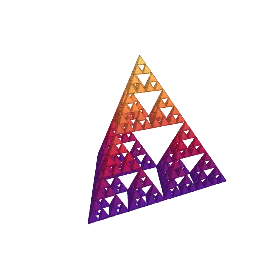 Sierpinski TetrixA Sierpinski tetrahedron is a fractal pyramid.
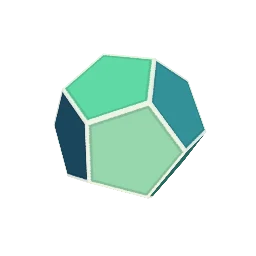 Platonic SolidsThe Platonic solids are the only five convex polyhedra whose faces are all the same regular shape, meeting in the same way at every corner: the tetrahedron (4 triangles), the cube (6 squares), the octahedron (8 triangles), the dodecahedron (12 pentagons) and the icosahedron (20 triangles).
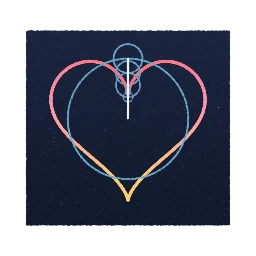 Fourier CirclesCircles turning on circles can draw almost any closed shape, given enough of them.
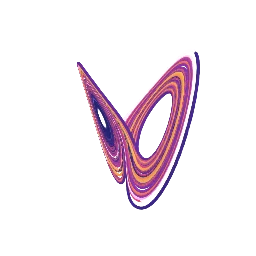 AttractorsIn 1963 the scientist Edward Lorenz made a very simple model of moving air: three short equations.