Menger Sponge
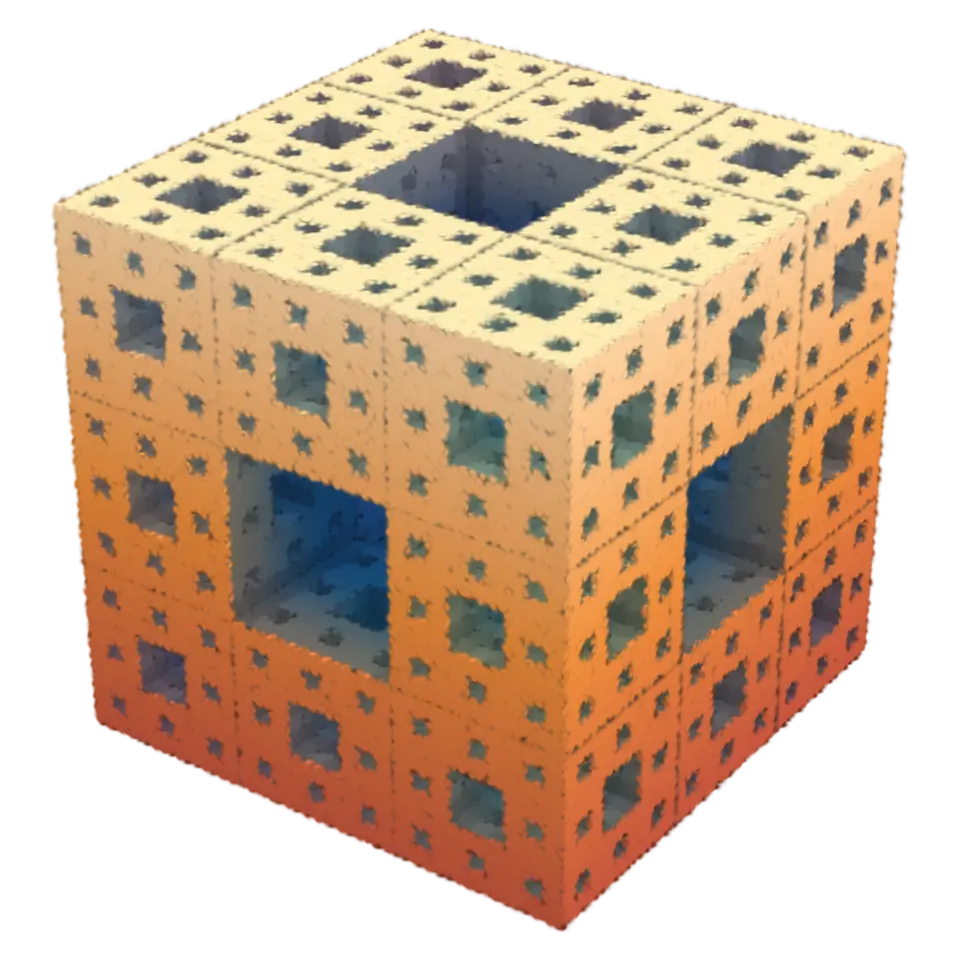
A Menger sponge is a fractal.
This picture is a cloud of paint. You can , , , , , , and .
Paint with your finger. It stays on these splats, wherever they go next.
Your paint is on this cloud. to see the sharp picture.
- Shelf
- Math
- Kind
- Built from a recipe
- Sound
- Yes
- Hands-on
- Yes
- Licenses
- Own work (made in the page)
How to play
Tap to close and carve the holes. Hands-on: pull the small cubes out one by one.
Its controls
| Control | Kind | Range | Start |
|---|---|---|---|
| Close and carve the holes | Tap | ||
| Carve | Button | ||
| Level | List | 2 choices | Level 3 |
About it
A Menger sponge is a fractal. Start with a cube and cut it into 27 smaller cubes, like a puzzle cube. Take out the one in the middle and the six at the middle of each face, leaving 20. Then do the same to each of those 20 cubes, and again, forever. Karl Menger described it in 1926.
Tap it and every hole is plugged, the smallest first, until it is a plain cube. Then it is carved again: the big cubes slide out of the faces, then the next size down, then the smallest. Pick level 2 or 3 in the Splash tab: level 2 keeps 400 little cubes, and level 3 keeps 8,000.
Details
- Splats
- Opens at 200,000 at Mid Detail, 59,998 at Low, and up to 999,983 at Max
Sources and credits
Made in Splashery. Its code is MIT.
Share it
This link opens it in the Playground. To put it on your own page, add the element and one script tag. Every option.
https://splashery.app/play/?toy=menger-sponge
<script type="module" src="https://splashery.app/play/src/element.js"></script>
<splashery-toy toy="menger-sponge"></splashery-toy>
Nearby
 Sierpinski TetrixA Sierpinski tetrahedron is a fractal pyramid.
 4D ShapesA hypercube, or tesseract, is a cube in four dimensions.
 MandelbulbThe Mandelbulb is a 3D fractal, a cousin of the famous flat Mandelbrot set.
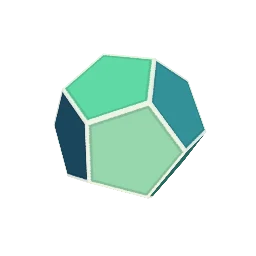 Platonic SolidsThe Platonic solids are the only five convex polyhedra whose faces are all the same regular shape, meeting in the same way at every corner: the tetrahedron (4 triangles), the cube (6 squares), the octahedron (8 triangles), the dodecahedron (12 pentagons) and the icosahedron (20 triangles).