Hurricane
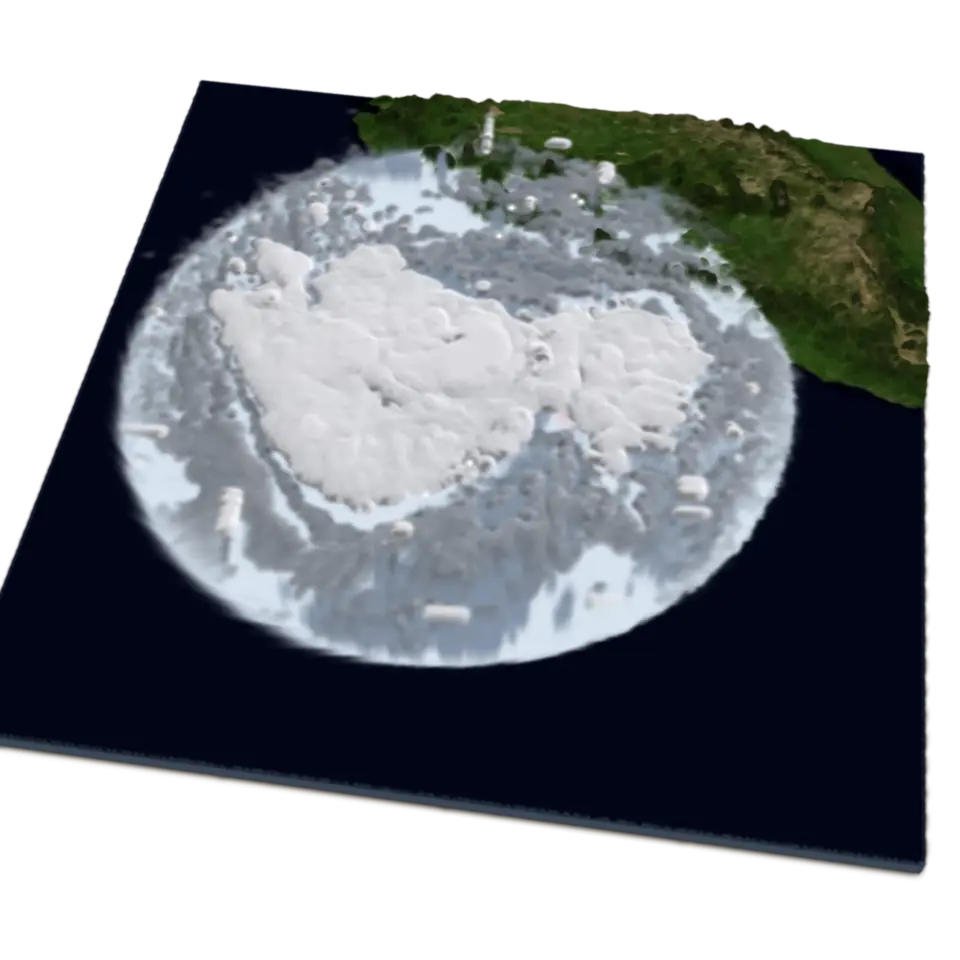
Hurricane Polo grew over the warm eastern Pacific, off the coast of Mexico, in September 2026.
This picture is a cloud of paint. You can , , , , , , and .
Paint with your finger. It stays on these splats, wherever they go next.
Your paint is on this cloud. to see the sharp picture.
- Shelf
- Earth and Maps
- Kind
- Built from a recipe
- Sound
- Yes
- Licenses
- Public domain
How to play
Tap to play the day Polo grew from 70 to 155 knots; tap again to go back to the start.
Its controls
| Control | Kind | Range | Start |
|---|---|---|---|
| Play the day it grew | Tap | ||
| September 22 | Switch | Off |
About it
Hurricane Polo grew over the warm eastern Pacific, off the coast of Mexico, in September 2026. In the 24 hours from September 21 to 22 its strongest winds rose from 70 to 155 knots (about 290 kilometers an hour), a burst forecasters call rapid intensification, and a clear eye formed in its center.
The clouds are built from infrared pictures from NOAA's GOES-East satellite at the start and end of that day: colder cloud tops are higher, so each cloud stands as tall as its temperature says. They turn counterclockwise around the eye, faster near the center, with rain falling and low winds spiraling in. Tap it to play the day: the storm follows its best track from the National Hurricane Center, the early ragged clouds give way to the later ones, and it spins faster as it strengthens. The two pictures are real; the change between them is a blend.
Details
- Splats
- Opens at 200,000 at Mid Detail, 83,796 at Low, and up to 610,000 at Max
Sources and credits
| Work | By | License |
|---|---|---|
| GOES-East ABI band 13 (clean infrared), through NASA GIBS | NOAA NESDIS (imagery served by NASA's Global Imagery Browse Services) | Public domain |
| Best track of Hurricane Polo (EP17, 2026) | NOAA National Hurricane Center | Public domain |
| Blue Marble: Next Generation (true color), through NASA GIBS | NASA Earth Observatory | Public domain |
| ETOPO1 Global Relief Model | NOAA National Centers for Environmental Information | Public domain |
In The Splash Manual
Share it
This link opens it in the Playground. To put it on your own page, add the element and one script tag. Every option.
https://splashery.app/play/?toy=hurricane
<script type="module" src="https://splashery.app/play/src/element.js"></script>
<splashery-toy toy="hurricane"></splashery-toy>
Nearby
 The Sea FloorThe Mariana Trench in the western Pacific is the deepest place in the ocean: its Challenger Deep is nearly 11 kilometers (about 7 miles) down.
 Bar Harbor TidesTides are the slow rise and fall of the sea, pulled by the Moon and the Sun.
 Grand CanyonThe Grand Canyon in Arizona is about 1,800 meters (a mile) deep, cut by the Colorado River over the last five or six million years through layers of rock laid down over almost two billion years.
 Mount St. HelensHelens, a volcano in Washington State, erupted on May 18, 1980.