Galaxy in a Box
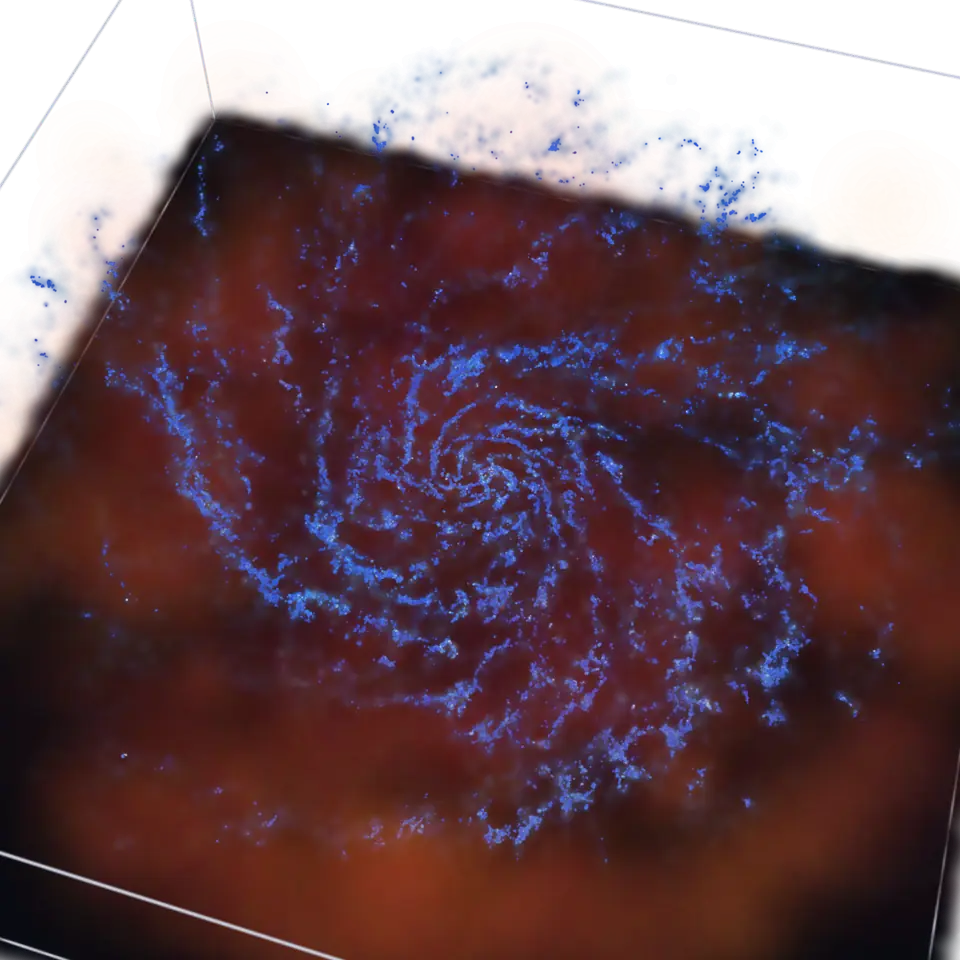
Galaxy simulations follow gas and stars as particles.
This picture is a cloud of paint. You can , , , , , , and .
Paint with your finger. It stays on these splats, wherever they go next.
Your paint is on this cloud. to see the sharp picture.
- Shelf
- Science
- Kind
- Built from a recipe
- Sound
- Yes
- Licenses
- CC BY 4.0
How to play
Pinch to zoom into the gas; tap to peel the hot gas. Through the telescope, tap for a new exposure.
Its controls
| Control | Kind | Range | Start |
|---|---|---|---|
| Peel away the hot gas | Tap | ||
| Only the cold gas | Switch | Off | |
| A new exposure | Switch | Off | |
| Galaxy | List | 3 choices | A Milky Way–mass galaxy today |
| View | List | 2 choices | The gas (the simulation) |
| Telescope filter | List | 3 choices | Color (blue, green and red) |
| Telescope's sharpness | List | 3 choices | A good night on the ground (1″) |
| Color by | List | 2 choices | Temperature |
| The box | Setting |
About it
Galaxy simulations follow gas and stars as particles. These are subsets of three FIRE-2 simulations: a galaxy of roughly the Milky Way's mass today, the same galaxy 10.4 billion years ago, and a dwarf galaxy. They are simulations, not telescope images. Each gas particle is a Gaussian about as wide as its smoothing kernel (the real kernel isn't Gaussian), colored by temperature or density; tap to keep only the cold gas.
Through a telescope (simulated) shows what an observer might record if the galaxy were 160 million light-years away: its star particles, bluer and brighter when young, blurred by the telescope's sharpness, with cold, dense gas dimming them like dust. Choose a filter; each tap starts a new exposure whose grainy photon noise smooths out as light builds up. The colors use a rough rule for how starlight fades with age, so it is a picture to explore, not a measurement.
Details
- Splats
- Opens at 200,000 at Mid Detail, 58,499 at Low, and up to 200,000 at Max
Sources and credits
| Work | By | License |
|---|---|---|
| FIRE-2 cosmological zoom-in simulation m12i, snapshot 600 (z = 0), gas | The FIRE project: Wetzel et al. (2023, 2025), Hopkins (2015), Hopkins et al. (2018); m12i from Wetzel et al. (2016). A subset: 300,000 of the 2.45 million gas particles in a 40 kpc box round the galaxy | CC BY 4.0 |
| FIRE-2 cosmological zoom-in simulation m12i, snapshot 172 (z = 2), gas and stars | The FIRE project: Wetzel et al. (2023, 2025), Hopkins (2015), Hopkins et al. (2018); m12i from Wetzel et al. (2016). A subset of the particles in a 24 kpc box round the galaxy | CC BY 4.0 |
| FIRE-2 cosmological zoom-in simulation m11h, snapshot 600 (z = 0), gas and stars | The FIRE project: Wetzel et al. (2023, 2025), Hopkins (2015), Hopkins et al. (2018); m11h from El-Badry et al. (2018). A subset of the particles in a 16 kpc box round the galaxy | CC BY 4.0 |
Share it
This link opens it in the Playground. To put it on your own page, add the element and one script tag. Every option.
https://splashery.app/play/?toy=galaxy-box
<script type="module" src="https://splashery.app/play/src/element.js"></script>
<splashery-toy toy="galaxy-box"></splashery-toy>
Nearby
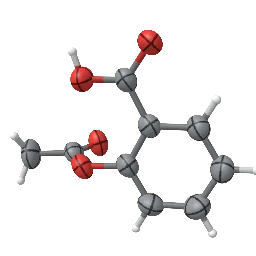 Thermal EllipsoidsCrystallography describes an atom's average position and spread with a displacement tensor.
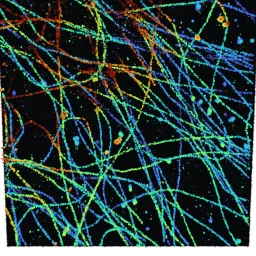 Super-Res MicroscopeOrdinary light microscopy struggles to separate nearby objects about 200 to 300 nanometers apart.
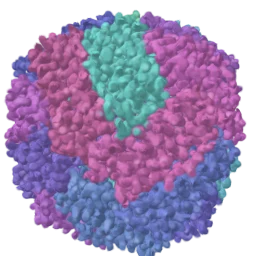 Cryo-EM MapCryo-electron microscopy freezes thousands of copies of a molecule in thin ice, photographs them with electrons and averages the pictures into a 3D map of density.
 Contour LabA contour line joins places at the same height, and a map with them shows a 3D shape on flat paper.